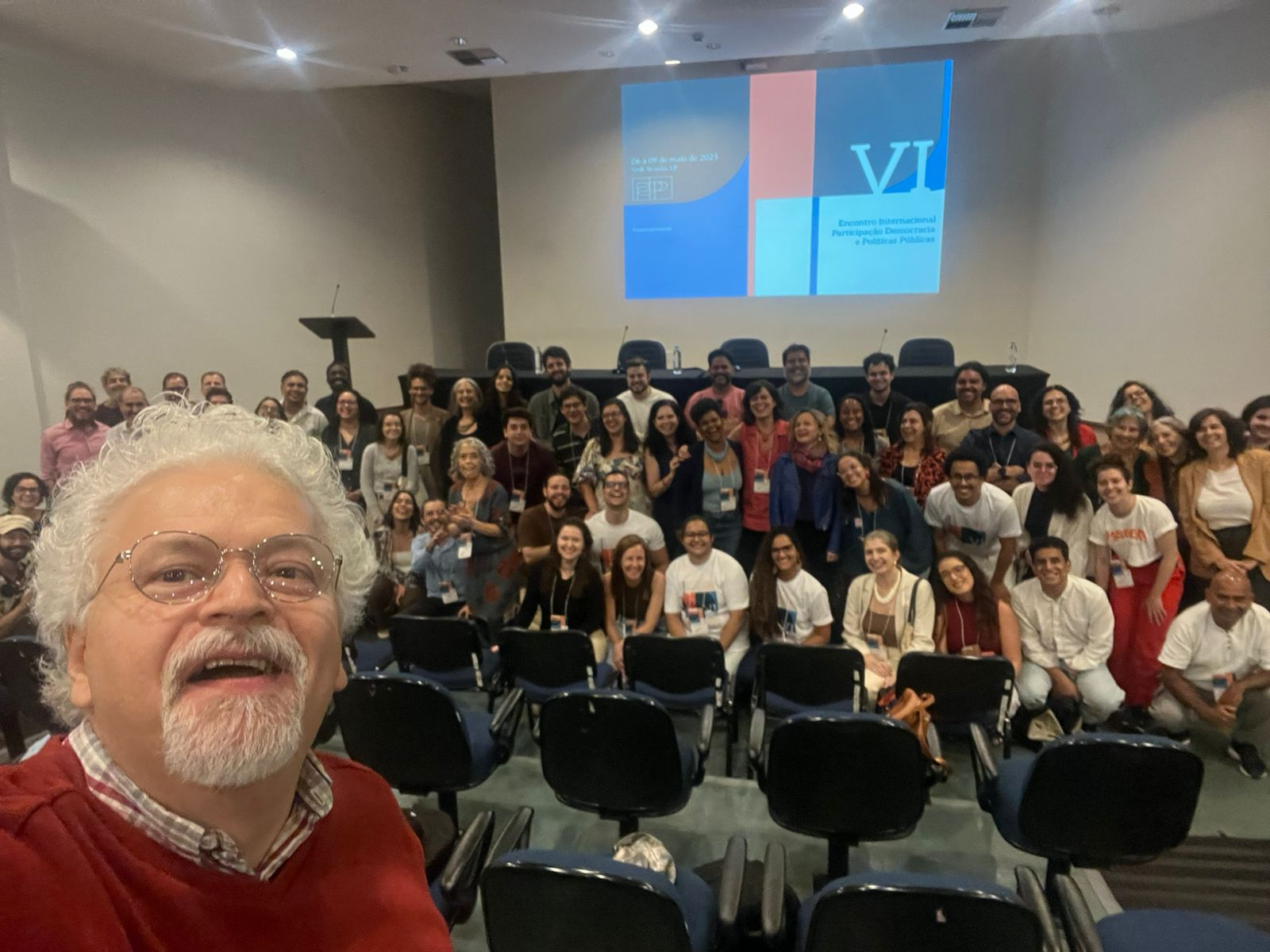
The 6th International Meeting on Participation, Democracy and Public Policies (PDPP) took place at the University of Brasília (UnB), in Brasília, from 6 to 9 May. The event was organised by UnB’s Institute of Political Science (IPOL). It gathered 548 paying participants and featured 12 thematic seminars, nine round tables, eight book launches and three short courses. Nearly 60% of attendees were women.
"The PDPP has become a fixture in the calendar for topics related to civil society participation and social movements. That’s quite an achievement, considering it’s not organised by a professional association, but rather by a network of research centres committed to creating space for new generations to emerge,” says Adrian Gurza Lavalle (USP), coordinator of INCT Participa.
Researcher Carla Gandini Giani Martelli (Unesp) highlights this formative role of the PDPP, which included the participation of students at various stages of their academic careers, such as undergraduate research, master’s and doctoral programmes. “Our students involved with INCT had the opportunity to build knowledge collectively, in an event that incorporates actors beyond academia. That’s extremely important,” says Carla, who teaches at Unesp’s Araraquara campus, where the first PDPP was held in 2013. “The PDPP has gained momentum and scale, spreading across the country. It’s a very welcoming event,” she adds.
Adrian also emphasises how the PDPP attracts colleagues from other fields who have an interest in participation. “It’s an important space for dialogue on the themes that bring us together and for shared agendas.”
Rebecca Abers (UnB) recalls the outcomes already generated by the PDPP, such as the book Participation and Activism: between setbacks and resistance, a collaborative effort among researchers from four research groups, with contributors from various universities.
There is also the INCT Participa itself, an institutionalisation of this collective network studying state–society relations, created in 2024. “I’m not aware of another academic community quite like it, where egos give way to a shared commitment to carry forward a collective endeavour,” says Rebecca.
For Euzeneia Carlos (UFES), the 2025 edition stood out, among other aspects, for being the first to offer short courses, delivered by professors and researchers. She also highlights the visits to centres of power, such as the National Congress. “The event enabled genuine dialogue between public authorities and civil society, with the aim of influencing and shaping public policy processes,” says Euzeneia.
At the closing session of the PDPP, on Friday the 9th, the Participa Observatory (OPar) was launched – a collective initiative to systematise and make data on social participation available, both nationally and internationally. OPar released its first database, MUNICs, which aims to support and encourage research on municipal governance, with an emphasis on participatory councils in Brazil.