


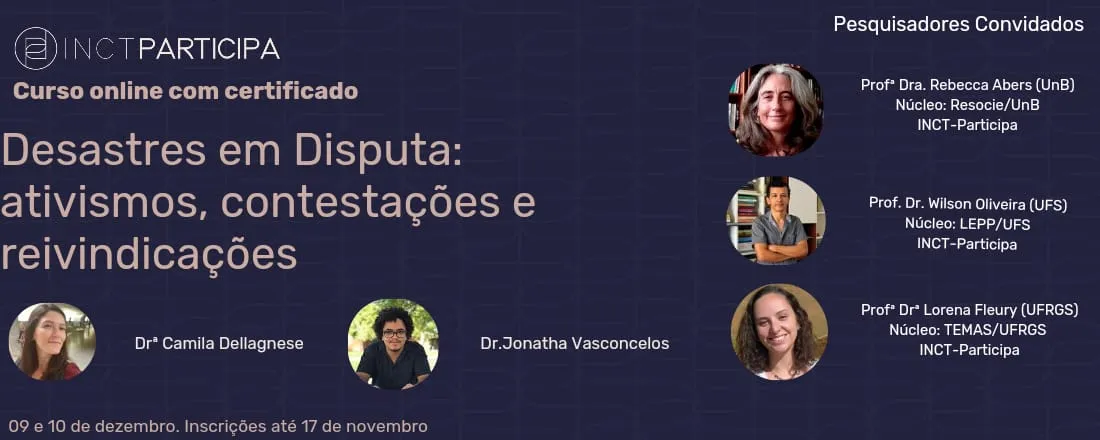
Taught by post-doctoral students Camila Dellagnese (UFAL) and Jonatha Vasconcelos (UFS), the mini-course had the special participation of professors Lorena Fleury (TEMAS/UFRGS) and Rebecca Abers (Resocie/UnB) and professor Wilson Oliveira (LEPP/UFS).
Research conclusions and hypotheses from ongoing studies, methodological and theoretical issues, examples of mobilization, participation, associativism and political confrontations were presented, as well as a series of questions, including ethical issues.
What is participation? How to deal with the difficulties of research? How to work with the ideological and political conceptions of the actors analyzed? And in the specific case of environmental disasters: how to build categories in scenarios that change over time? What can we learn from the mobilization of civil society in these contexts? And what happens to this acquired knowledge after the normalization of these territories?
These and other questions were raised by the network's researchers.
DEBATES
On the first day, the discussions revolved around the mobilization of civil society in the face of the sinking of Maceió, caused by the decades-long drilling of the Alagoas capital's subsoil by the petrochemical company Braskem.
Using concepts from the sociology of disasters and Social Studies in Science and Technology, Dellagnese presented his research, which emphasizes scientific knowledge by analyzing how contemporary science is intertwined with socio-environmental crises. Professor Lorena Fleury (TEMAS/UFRGS) also took part.
On the second day, the mobilization and participation of civil society during Covid-19 came up for debate. Vasconcelos presented his research on pandemic mitigation actions in Sergipe.
Highlighting the population's battle against Covid-19 and the pressure from the business and trade sectors to maintain an economic routine, he presented the data from the study which analyses 46 civil society initiatives, including public acts and protests, actions to mitigate the social impacts of the pandemic and the participation of civil society organizations in the public debate.
Regarding the protests in the region, for example, he says they were carried out by professional categories and not by the people “who were being affected at the edge and who saw death much more closely”.
“In the outskirts, you had a deeper impact around the lethality of Covid 19. People were crowding public transport, while other categories managed to be safe in the workplace,” he said.
The debate had the special participation of Professor Wilson Oliveira (LEPP/UFS) and Professor Rebecca Abers (Resocie/UnB) who brought the experience of the Mobiliza Covid-19 Repository, created in 2020, to give visibility to efforts during the pandemic and understand how civil society mobilizes in times of crisis.
WATCH
Disasters in Dispute: activisms, contestations and claims was the first mini-course in a series aimed at training the network's more than 200 members. The event is restricted to researchers and opened with around 30 participants.
Follow the calls for upcoming INCT Participa mini-courses on this website, which are aimed exclusively at members of the Institute. Certificates will be offered.


