


At the end of August, the seminar “Disinformation and Territory: Community Strategies of Resistance” took place in Belo Horizonte, organized by the Agência de Iniciativas Cidadãs (AIC), the Observatório Participativo da Desinformação, and the Federal University of Minas Gerais (UFMG), with support from the research group Margem and the INCT Participa.
The event featured four panels. The first, “Territorialized Confrontation of Disinformation,” brought together Fábia Lima (UFMG), Ednéia Aparecida (MNLM), and Monge (Batalha Griot) to discuss experiences in combating disinformation within the Hip Hop movement, in peripheral communities addressing housing issues, among university youth, and the role of public universities in facing this challenge. The panel was moderated by Manu São Pedro (AIC).
The second panel, “Networks and Streets – Strengthening Community Communication to Confront Disinformation,” featured Letícia Cesarino (UFSC), Lorrayne Batista (Conecta Cabana), and Ricardo Fabrino (UFMG), who reflected on real-life disinformation—the speed and volume of misleading content affecting those living in these territories, the challenges faced by community communicators, and the importance of combining digital media with in-person engagement rooted in the originality of local actors. The session was moderated by Warley Bombi (Periferia que Fala).
In the panel “Disinformation and Religion,” Father Mauro (Muquifu), Pastor Patrícia Santos (Comuna do Reino), Josué Gomes (UFMG), and Luciana Oliveira (UFMG) discussed the impacts of disinformation that exploits religious beliefs to harm minority groups. The moderator was Roju Soares (ECOAR).
Finally, the panel “Disinformation, Public Communication, and Access to Rights” featured Elaine Pinheiro (CDC Morro do Papagaio), Vanessa Veiga (UFMG), and Lília Gomes (ABCPublica), who shared experiences using different tools—from artificial intelligence to community communication—to reflect on strategies needed to address this issue. The panel was moderated by Tiago Toth (ANEDUC).
The event also included artistic performances, such as rap verses by Monge and Kety MC addressing themes related to disinformation. BS (Irineu Junior), San 97 (Sanderson Gabriel Ferreira Silva), and Poesia (Felipe Fernandes de Carvalho), members of Rima Viva Hip Hop Crew, created a graffiti mural linking knowledge, information, and culture. Joi Gonçalves brought spoken word poetry to address disinformation and its impacts.
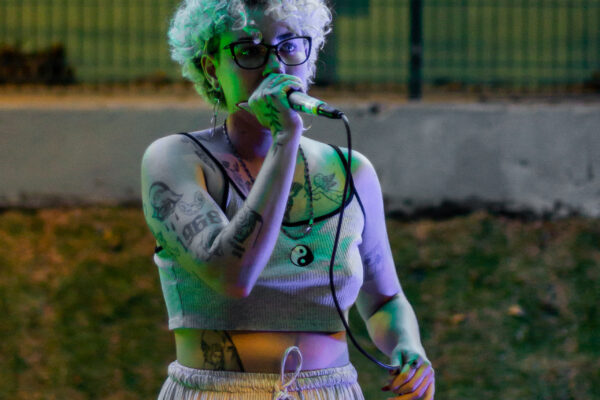 The seminar featured artistic performances by "grassroot" intellectuals
The seminar “Disinformation and Territory” is one of the final initiatives of the Observatory, which was created in 2023 with the goal of strengthening, connecting, and promoting community-based initiatives to combat disinformation.
“Disinformation is not a new problem, but it has new faces. It interacts with spaces of vulnerability,” says Juliano Canedo Antunes, from the Participatory Observatory on Disinformation. For this reason, the organizers sought to hold a seminar that was not strictly academic but also brought together “grassroots intellectuals who are building forms of resistance against disinformation,” Juliano explains.
In addition to the event, the magazine “Participatory Observatory on Disinformation: Listening, Participation, and Ways of Confronting Disinformation” was published, featuring insights from 96 community leaders involved in youth education in peripheral areas, as well as lessons learned through the project’s collaborative work across various territories. [Access it here.]
The Participatory Observatory on Disinformation won the Extension Recognition Award at the 6th International PDPP Meeting. The project originated during the pandemic, when community groups and grassroots leaders sought support to combat disinformation about COVID-19 through materials and strategies tailored to their local realities.
The Participatory Observatory on Disinformation team includes Aline Franceschini, Caroline Messias, Emanuela São Pedro, Juliano Antunes, Júnia Martins, Luiza Avelar, Maria Caram, Ricardo Fabrino, Sthefanny Barbosa, and Thiago Henrique Lopes.
Learn more about the project here.


