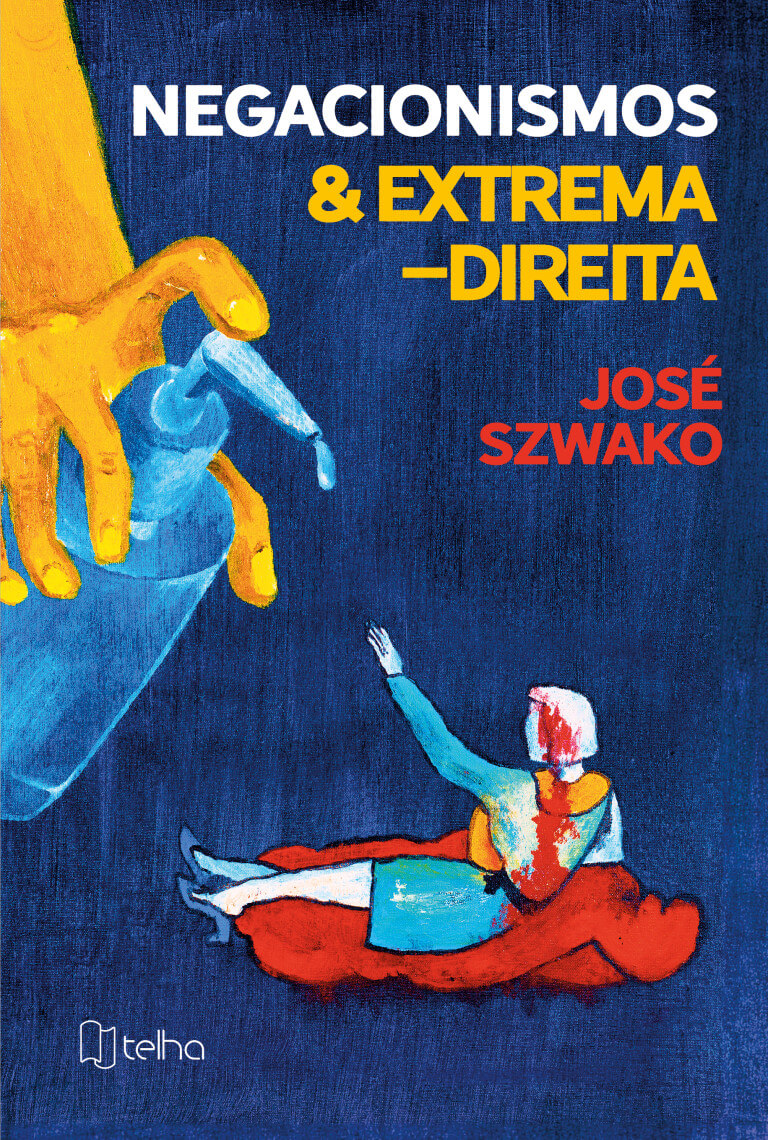
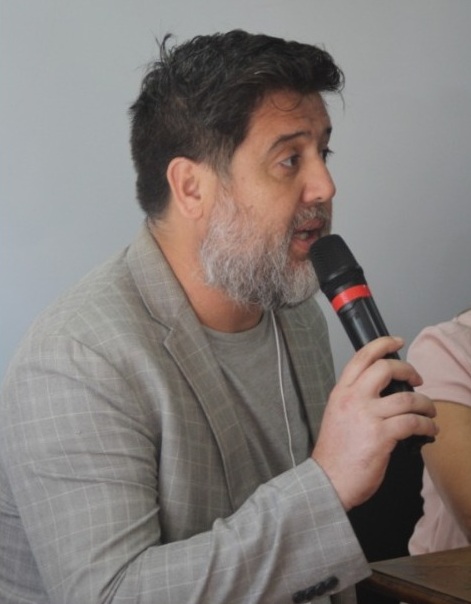
The book “Denialisms & the Far Right”, written by José Szwako and published by Telha Editora, has just been released. Szwako, a researcher at IESP-UERJ, NDAC/CEBRAP, and affiliated with INCT Participa, examines how reactionary discourses align against science, democracy, and rights, exploring the strategies and actors that sustain this dynamic.
José Szwako holds a Ph.D. in Social Sciences from Unicamp and studies the history of civil society in Brazil.
Together with J. L. Ratton, he co-authored the “Dictionary of Denialisms in Brazil” — a finalist for the 2023 Jabuti Prize. He is also the editor of the “Sociedade Política” collection (IESP-EdUERJ) and the creator and coordinator of the Specialization in Politics and Society program (IESP-UERJ).
Read INCT Participa’s interview with the author.
★
How did the book come about?
When the pandemic coincided with the rise of the far right in Brazil, I needed to rethink the research agenda on social movements and public policies that I had been studying for 15 years. My research had always focused on progressive movements. The central challenge in studying denialism is to understand whether these phenomena could be seen as movements in the same way we understand others — that is, organized networks with activism and identity. A central finding of the book is that denialism is not well understood as a movement. The idea of a movement, although it may seem simple, requires collective action and rationality. Denialism is certainly a coordinated action, but its foundation is not a shared identity that generates action, as in the Black, feminist, or anti-feminist movements. So what is the foundation of this action? That’s what the book seeks to answer.
What “truth” does denialism deny?
This investigation led me to dialogue with the social studies of science, where you realize that science itself also has non-institutional foundations — ideological, moral, sometimes even religious. In a more contemporary version of the critique of science, it does not coincide with “truth” but rather produces new consensuses. Using a Popperian term, it’s a process of fabricating propositions or hypotheses — meaning these consensuses are by definition unstable. Thirty years from now (hopefully not just five), someone will say that my perspective is limited and needs to be rethought, just as we do with earlier generations of social and political scientists. We don’t have a religious relationship with science; we’re not searching for “the truth.” Any somewhat reflective scientist knows that well.
So how does denialism operate?
Some consensuses are far more stable than others. For example, that HIV is connected to AIDS — it would be almost impossible for someone to claim otherwise, just as it’s well established that tobacco greatly increases the risk of cancer. What denialists do is not deny the truth — because “truth” exists only in the mind of someone who doesn’t understand science — but rather produce false doubts. Doubt is part of our scientific practice. So they cast doubt where there are already well-established consensuses, such as on global warming or the fact that the Earth is round. At the same time, denialism emulates, copies, and mimics science — and journalism too, another institution I discuss in the book. If you open a denialist website, its news production logic looks like that of a legitimate news site. They’ve built an entire aesthetic of their own “science.”
Are they successful in doing that?
The far right, contrary to what many think, is effective not because of a supposed crisis in science, but precisely because of science’s public success. There is enormous trust in science. These far-right groups, organizations, and parties use science within their repertoire — to distort and falsify it. They do this because science holds credibility in society, and they know that invoking it makes their claims more persuasive. A very common phrase in denialist rhetoric is “studies show that…” — they use it because they know it works.
Was June 2013 the starting point for denialist movements in Brazil?
Contrary to what people often think, 2013 was not the origin but the result of earlier political dynamics, especially growing discontent within the left regarding the government — after all, it was a progressive fraction of civil society that triggered the protests. At the same time, there was dissatisfaction with certain public policies that affected military interests, especially those in the area of human rights. The military’s estrangement from Dilma’s government was far from trivial — it played a central role in Bolsonaro’s emergence as a public figure. Research by Angela Alonso and Camila Rocha shows that right-wing groups were already organized. The National Truth Commission inflamed the military, but even before that, the seeds of the collapse lay in the Third National Human Rights Plan.
What happens to denialists and the far right amid changing governments — sometimes Trump, then Biden; sometimes Bolsonaro, then Lula?
This radicalization scenario doesn’t depend solely on who governs — it won’t disappear with any given election. It can deepen under right-wing or far-right governments. The current moment is regressive, not polarized — marked by a conservative, ultra-conservative, and radicalized hegemony, hence far-right. It’s crucial to distinguish between a right that accepts the rules of the game — the one that consolidated after World War II — and the far right we see now. New elements, such as the internet and the reconfiguration of work, have transformed the landscape. And regarding science: yes, there is a crisis, but it’s a budgetary one — spanning center-left and center-right governments alike. That’s not what people are talking about when they speak of a “crisis of science.”
Learn more about the book “Denialisms & the Far Right.”
Author: José Szwako
Publisher: Telha Editora
Year of publication: 2025
Pages: 232
Price: R$ 72.00