Throughout history, democratic governance has been the subject of disputes between defenders and critics of democracy within organizations. Although it is increasingly recognized and demanded, we still largely lack deeper investigations into the meaningful connections between democracy, organizations, social movements, and solidarity finance.
Democratic Governance in Social Movement Organizations analyzes the multiple factors that influence and sustain democratic governance in solidarity finance organizations. By conducting a comparative analysis between community banks in Brazil and ethical banks in Spain, the book offers causal explanations for organizational dynamics and provides analytical–conceptual systematizations.
By proposing a theoretical model for analyzing configurations of democratic governance — the Democratic Confluence Model and the Oxê Quadrilateral — Leonardo Leal’s Democratic Governance in Social Movement Organizations is aimed not only at researchers engaged in their respective fields of study but also at practitioners involved in democratization processes within social movement organizations.
Leonardo Leal is a professor in the Public Administration program at the Federal University of Alagoas (UFAL) and coordinator of the Laboratory for Research and Action in Democratic Innovation (LAPID) and the Technological Incubator for Solidarity Economy (ITES). LAPID is a partner center of INCT Participa.
Read INCT Participa’s interview with the author.
★
What exactly is democratic governance?
The idea of democratic governance is quite flexible and encompasses a set of principles, values, practices, and methodologies that guide decision-making processes based on participation and deliberation. In my work, I focus on how this manifests within social movement organizations. I understand democratic governance as a repertoire of political prefiguration—that is, as a form of everyday political practice that anticipates and experiments with alternative ways of organizing power and decision-making in social movement organizations.
In my approach, I identify four main models of democratic governance:
a) the deliberative participation model,
b) the assembly model,
c) the deliberative representation model, and
d) the associative model.
These models are neither static nor mutually exclusive. On the contrary, they combine and overlap, shaping democratic practices according to the contexts and dynamics of each organization.
Why analyze democratic governance in solidarity finance organizations? Why community banks in Brazil and ethical banks in Spain?
I chose these cases because both the community banks in Brazil and the ethical banks in Spain represent highly significant experiences of social movements that combine economic and political action in the construction of common goods. They provide financial services under a regime of democratic decision-making, which makes their governance a strategic space for both contestation and innovation.
Analyzing democratic governance in this field is essential to understanding how these organizations handle structural dilemmas—such as balancing efficiency and identity, or autonomy and integration. They emerge in a context marked by a crisis of democratic representation and increasing financial exclusion, while also facing the strong dominance of financial capital.
Community and ethical banks respond to these challenges by offering financial services grounded in ethical and solidarity-based principles. Moreover, by experimenting with democratic forms of organization in their daily practices, they serve, in many ways, as laboratories of political and economic innovation.
What were the main findings of the study? What new insights does it offer?
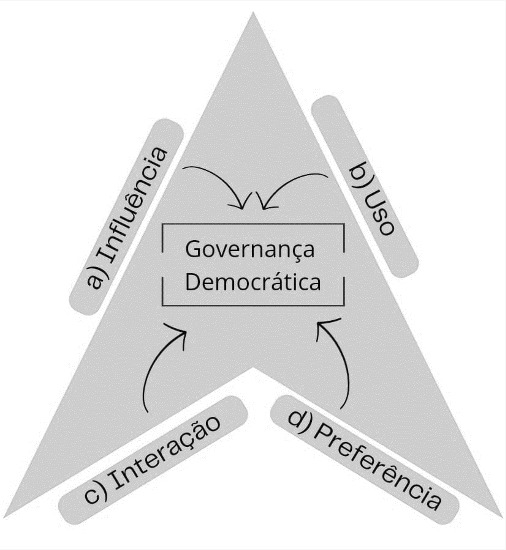
The core findings can be summarized around several key elements. I explain the outcomes of democratic governance in these banks through a configuration of conditions that include:
- the influence of social movements and public arenas,
- the use of shared financial resources,
- interactions with public policies, and
- the preference for political consumption.
An important conceptual contribution is what I call the “Oxê Quadrilateral”, which represents how democratic governance is sustained through these conditions and interactions. This perspective helps to show that democratic governance is not merely a set of internal rules but rather a relational phenomenon, occurring at the intersection of organizational practices, social networks, and political arenas.
The Democratic Confluence Model emerges from the direct observation of democratic governance practices in social movement organizations — especially in community and ethical banks. Its central idea is to understand how participatory and deliberative processes interact when actors connect the organization’s internal dynamics with the territory in which they operate.
On one side, there is the organizational dynamic, which involves decision-making procedures typical of associative and cooperative structures — such as assemblies, councils, and decision-making committees. These are more structured and institutionalized spaces, where strategic and operational decisions are made.
On the other side lies the territorial dynamic, which extends the decision-making process beyond the walls of the organization. It incorporates territorial networks and actors through open public debates, forums, and plenaries. In this more fluid and plural space, community leaders, collectives, activists, local producers, and other formal and informal actors connected to the territory participate.
The confluence between these two dynamics — organizational and territorial — creates a hybrid space of governance in which decisions are not limited to a closed governing body but emerge from broad and democratic interactions. It is this weaving together of different arenas that characterizes the Democratic Confluence Model.
You mention that the book is not only aimed at researchers but also at practitioners. Can you elaborate on that?
Yes. Although the book has a strong theoretical and analytical foundation, I have always conceived it as a tool for reflection and action for the actors themselves — those who build solidarity finance experiences and other initiatives of economic democracy in their daily lives. The book has very concrete practical implications.
First, I show that there is no single ideal democratic model. On the contrary, many organizations combine different forms of governance, such as direct participation and delegation, or decision-making based on voting and consensus. This flexibility helps organizations find arrangements best suited to their own realities.
A second point is the importance of alliances with social movements and public arenas. Democratic governance cannot be achieved in isolation. When organizations connect to networks, collectives, and broader public spaces, they gain legitimacy, expand their resource base — political, economic, or solidarity-based — and, most importantly, they learn. Internal democracy is strengthened through engagement with the surrounding environment.
Another key element is the role of shared financial resources. These are not neutral: they shape behaviors, power relations, and priorities. The book helps practitioners reflect on how the use of such resources can reinforce solidarity and autonomy rather than reproduce traditional market logics.
I also discuss organizational hybridization, meaning the coexistence of participatory practices and professional technical management. The idea is not to choose between democracy and efficiency, but to design institutional arrangements where managerial expertise serves democratic governance — and remains under its control.
Finally, I introduce the notion of political consumption of financial services. When someone chooses to use credit, savings, or other services from a solidarity-based institution, they are doing more than a simple transaction: they are affirming values and supporting democratic practices. This perspective broadens the role of users, turning them into political agents.
In summary, my book offers analytical and practical tools for social actors themselves to assess, strengthen, and reinvent their democratic practices.
And how did the book come about — was it based on a specific research project, or written especially for this publication?
The book stems directly from research I have been conducting for several years on participation and deliberation within the solidarity economy movement, focusing on community banks in Brazil and ethical banks in Spain. It compiles and updates the main findings of my doctoral dissertation, carried out in cotutelle between the University of Brasília and ISCTE – University Institute of Lisbon. In the dissertation, I was already analyzing how these organizations create their own innovative democratic arrangements, and the book deepens and expands that reflection.
The invitation to publish came from the Instituto Ateliê de Humanidades, as part of the Metamorphoses Series — a collection of reference works dedicated to themes such as associativism, solidarity economy, social management, democracy, and public action. The idea was to make the research results more accessible to diverse audiences. More than an academic record, the aim was to contribute practically and critically to the contemporary debate on democratic innovations and to show how concrete practices can inspire new ways of thinking about — and practicing — democracy in everyday life.
Learn more about the book Democratic Governance in Social Movement Organizations
Author: Leonardo Leal
Publisher: Ateliê de Humanidades Editorial
Year of publication: 2025
Number of pages: 275
Price: R$ 75.00