


The researcher Rebecca Neaera Abers is a full professor at the Institute of Political Science at the University of Brasília. Born in California, she has been visiting Brazil since 1988 and has lived in the country permanently for nearly 30 years. “I think I understand the United States less than I understand Brazil,” she says in an interview with INCT Participa ahead of the Anpocs conference.
At this year’s event, held at Unicamp in Campinas, Rebecca Abers received, on Wednesday evening, October 22, the Anpocs Award for Academic Excellence Gildo Marçal Brandão in Political Science, one of the most prestigious recognitions in the field.
She holds a bachelor’s degree in Social Studies from Harvard University and a master’s and PhD in Urban Planning from the University of California, Los Angeles. Currently, she is the co-coordinator of the Research Group on State–Society Relations (Resocie), co–editor-in-chief of the Revista Brasileira de Ciência Política (RBCP), and a member of the managing committee of INCT Participa.
Her academic work focuses primarily on the relationships between social movements and the state, activism and political creativity, institutional transformation, bureaucracy, public policy, and participatory politics.
She is the author of Inventing Local Democracy: Grassroots Politics in Brazil (Lynne Rienner, 2000) and co-author, with Margaret E. Keck, of Practical Authority: Agency and Institutional Change in Brazilian Water Politics (Oxford, 2013; published in Portuguese by Editora Fiocruz in 2017). She also organized Ativismo institucional: criatividade e luta na burocracia brasileira (Editora UnB, 2021) and co-organized, with Marisa von Bülow and Débora Almeida, A disputa pela democracia no Brasil: ativismos em contextos turbulentos (Editora Zouk, 2023).
Read the interview with Rebecca Abers.
★
How has this recognition been for you?
Unbelievable. At the Anpocs conference where Evelina Dagnino — our great reference at INCT Participa and one of the founders of the field in Brazil — received the award, I remember looking and thinking, “how wonderful it must be to win this prize.” It’s such a gratifying recognition. I invited Marisa von Bülow to introduce me. I only told her, and we had to keep it secret for two months. I think that was actually nice. There were several stages to sustain the happiness until finally receiving the award.
About your journey — when did you first come to Brazil?
It was a crooked path. I’m from Los Angeles and studied at Harvard. I first came to Brazil in 1988 with a fellowship that gave me a lot of freedom. I went to Belo Horizonte, to the Regional Planning and Development Center at UFMG. My background was in social studies, and my focus was on health. That group studied malaria in the Amazon, but I ended up getting involved with research on urbanization in the region. I spent two years in Brazil, part of that time in Belém. I wanted to be in the Amazon. I did research in Roraima on the gold rush and how mining sustained the growth of Boa Vista. My master’s thesis was about that. Then I went back to the U.S. for graduate school at UCLA, wanting to study urban planning and turn research into public policy — to do something with real impact.
What was that period in Boa Vista like?
It was an adventure — a very interesting time. When we were there, President Collor sent the Federal Police to shut down the mines. Boa Vista had grown wildly in a short time; it was a sprawling city, with no infrastructure, and everything was expensive. I came to understand how the economy depends on practices that are harmful to the environment and to Indigenous peoples. Many poor people rely on mining. It’s complex.
Then you went on to urban planning at UCLA.
Yes, partly because of my advisor, John Friedmann, a theorist with a radical, bottom-up approach to urban planning, critical of top-down traditions. He was an influential person, and I became interested in studying not only the economic conditions but the political processes behind urban transformation. That was in 1992, when I finished my master’s and stayed in the same department for my PhD.
And how did you end up in Porto Alegre and with participatory politics?
I arrived in Porto Alegre in 1993, when the Workers’ Party (PT) was experimenting with new forms of local governance. Everyone was saying something different was happening there. In its first major electoral success, the party had won 36 city halls in 1988, including São Paulo, Porto Alegre, Santos, and Santo André. I visited six or seven of these cities to analyze different experiences. The theme of participation gradually emerged. It wasn’t clear at first that it was what I was looking for. I wrote an article about these participatory policies — not all of them successful — and my doctoral dissertation aimed to understand what worked and why.
Why is it important to understand what works?
I’ve been deeply influenced by the Austrian economist Albert Hirschman, whom I encountered through urban planning. He studied Latin America and developed a concept called possibilism, arguing that it’s important to study what’s probable, but equally important to study what’s improbable yet possible. Without looking at the unexpected — without understanding why those things happen — we can’t truly understand society. That idea connects with my own story: not seeking idealism or utopianism, but understanding what is possible.
And after Porto Alegre, where did you go?
I went back to Los Angeles to write my PhD dissertation. That’s when I started studying the participation literature. Carole Pateman, a major reference in the field, was on my committee, so she influenced me as well. I began studying social movements, civil society, associativism — themes of mobilization. I delved deeper into political institutions and their transformations. My dissertation sought to understand what I called a kind of “virtuous circle of causality” between state transformation — which made it possible to create truly participatory policies — and the resulting transformation of civil society, which mobilized. Peter Evans talks about the synergy between state and society. That’s how participation, social movements, and state-society relations became my lifelong themes.
When did you return to Brazil?
In 1997. My ex-husband, who is Brazilian, had the crazy idea of opening a bar in Natal. Later, we moved to Brasília, where my children were born. I was still working in urban planning, but I didn’t feel at home in that field. The research and theoretical frameworks of urban planning didn’t help much in understanding political processes. I began to think I belonged more in political sociology or political science, because I wanted to study political processes. At the time, I didn’t know that most political scientists don’t actually study processes — they study relationships and correlations, but not what happens between cause and effect.
How did you end up at the University of Brasília (UnB)?
I spent nine years in Brasília before getting a tenure-track position. Since the FHC administration, there had been a hiring freeze in federal universities. I stayed active academically through a major research project I coordinated with Margaret Keck, a political science professor at Johns Hopkins University. Many people think she was my advisor — in a way, she was — but I only met her after my PhD. We worked together on a project about watershed committees, where civil society, the state, and the business sector deliberate on water management and protection.
How do these committees work?
In 1998, a law created the National Water Resources Management System, a new framework for environmental and water-use governance. It was an emerging field of participatory spaces. With Margaret, I helped create the Marca D’Água project, which for years was my main source of income. There were about 40 of us studying 23 river basins. Margaret, in the U.S., provided intellectual guidance, while I coordinated daily operations. We wrote Practical Authority, where we discuss the political construction of institutions. This time, we didn’t study successful cases — it was difficult to create these committees. We focused on the new water governance structure, which went far beyond civil society’s participation in debates.
What is the focus of that book?
It’s about how creative actors build institutions that don’t come into being just because they’re legally constituted. It examines the role of action in social life. The social sciences often assume either that individuals have no freedom — that they’re victims of large power structures where only the powerful have agency — or, on the other extreme, that each person acts freely and rationally, as if the world were a free market. If you reject both approaches, it becomes harder to build a theoretical explanation, because it’s harder to predict what people will do. If people are selfish and rational, you can model their actions. If they’re determined by structures, you just need to know the structures. But if people are facing emergent problems, it’s very hard to predict their actions — and perhaps because of this unpredictability, the social sciences tend to avoid this perspective.
And your career at UnB?
I joined UnB, in the Institute of Political Science, in 2006. In 2012, I founded Resocie. We realized that the literature on social movements and civil society in Brazil was entirely focused on participation and participatory institutions, neglecting protest movements and contentious politics that didn’t necessarily take part in those spaces. This was during the early PT governments, when participatory institutions expanded, though far less than had been imagined in the 1990s, when PT had been at the center of participatory democratic innovation. At the federal level, the party was less creative; there wasn’t a major participatory project. Progress came mainly from the movements themselves, trying to influence the government. So we began to reflect on what that meant.
Was that when research on social movements began to grow?
Yes. Around that time, Evelina Dagnino published a book (2006) on democratic construction in Latin America. She worked with several people who are now part of INCT Participa, like Luciana Tatagiba, Carla Almeida, and Carla Martelli. They analyzed how different types of movement actors were moving between the state and society. Around the same time, Adrian Gurza Lavalle published an article arguing that social movements were still there — still important.
What other work from that period stands out to you?
In 2014, Luciana Tatagiba, Lizandra Serafim, and I published an article on the different ways movements from various fields interacted with state openness, and how traditions of state-society relations were being rethought and adapted. Movements didn’t just occupy participatory institutions — they redefined what we call repertoires of state-society interaction. That article had a surprising impact; it’s still the most cited piece in DADOS journal.
At one point, during our discussions about the role of social movements within the state, Margaret Keck made a comment: “Are the strategies of activists who came from social movements and now hold government positions different from those of bureaucrats who never had activist backgrounds?” That question shook me deeply. I decided to launch another study, this time focusing on career bureaucrats without activist histories, and started collecting cases of institutional activism. That became the basis of a book organized with Resocie students, completed in 2018 and published in 2021. It was an exciting opportunity to build theoretical discussion, based on a course I teach on political creativity — to think about what activism really is.
And what is activism?
I change my mind about what activism is all the time. People criticize me, and I change again. I drive everyone crazy [laughs]. I like that process — I don’t need to cling to my old ideas. I enjoy changing. In the book Institutional Activism, for example, I said activism had to involve collective action. Marisa von Bülow convinced me otherwise — that in digital activism, processes occur that bring people together, but we can’t always call that collective action. So I dropped that requirement in my more recent writing.
And what about during the Bolsonaro government?
When the Bolsonaro government began, I was following one policy in the environmental field and another in women’s health — both already being dismantled under Dilma. Under Bolsonaro, many people stopped answering me; my contacts were gone; I had to hold meetings outdoors, without a recorder, without taking notes. People were terrified by the political persecution and the risk of disciplinary action. I didn’t want to conduct research that could harm those I studied. Then came the pandemic, and Marisa and I created a repository mapping what civil society was doing in response to the crisis. That material became a research project. The goal was to understand how denialism shapes the ways social movements build anti-denialist strategies.
Going back to the beginning — how did you end up at Harvard?
I went to Harvard because I got in, and I couldn’t say no. It was impossible to turn down. It was a difficult experience — I wasn’t from that world or culture. It was socially strange, a heavy environment, and I left feeling incompetent. It was formative — I learned a lot — but it wasn’t a happy time at all.
And what did you study there?
I studied Social Studies, a program created by sociologists who broke away from mainstream American sociology. It was an alternative, interdisciplinary course — you had to study economics, history, and political science. Even in high school, in the 1980s, I was involved in movements related to immigration and against the Central American wars. During college, I went to Guatemala to study Spanish and volunteered in a hospital. It was a “wow” moment — I thought, I want to work with health. That never really took off, though.
How did your interest in Brazil arise?
I wanted to spend the year after graduation somewhere in Latin America. I had studied the region a lot and taken all the courses. I came to Brazil knowing it was a large and diverse country. I wanted somewhere dynamic and complex.
How do you feel about Brazil now?
The experience of coming from another place and getting to know a country deeply is fascinating. I think I understand the U.S. less than I understand Brazil. I arrived here in October 1988, at the moment the new Constitution was enacted. In a sense, I’ve only known Brazil in its democratization process — a project that seemed to me one of constant democratic progress. I found the country’s ability to deal with crises remarkable. The U.S. had long been a society unable to change. In Brazil, things happened; there was a kind of adaptability to turbulence. At the same time, there’s that saying, “Brazil is not for beginners.” I share that feeling of incomprehension. But I also don’t fully understand my own country of birth — so why should I understand Brazil? Maybe it’s not possible to truly understand any country.
And how was it to witness the destruction under Bolsonaro?
The end of that cycle of democratic progress made me realize I was more naïve than I thought. I was one of the people in the participatory field who pointed out a thousand problems, but when those destructive forces emerged — against the participatory democratic project, inclusion, and social justice — I found it emotionally hard to bear. I realized how invested I was. We started to defend as necessary what we had previously criticized as insufficient. If that had happened earlier in my time in Brazil, before I was so committed to the country, I might have said, “how interesting, a political upheaval.” But after 30 years, it was painful.
And what should be done now?
There’s broad consensus on the diagnosis, but little clarity on the prognosis. The diagnosis is that it’s not enough to rebuild participation — it has to be transformed. Before the right began dismantling participatory institutions, we were already critical of the existing models, which hadn’t achieved deep democratization. Most people didn’t even know those councils existed. Democratic progress wasn’t reaching large parts of Brazil — urban peripheries, Indigenous, rural areas. These processes also aren’t adapted to the digital world or new forms of sociability. They’re not reaching the grassroots or the networks. Lula’s third term has a project to rebuild participation. How do we overcome these challenges? That’s less clear. When I get discouraged, I return to Hirschman — I look for examples of what’s possible. I think that’s what we have to do now — it’s a guiding compass.
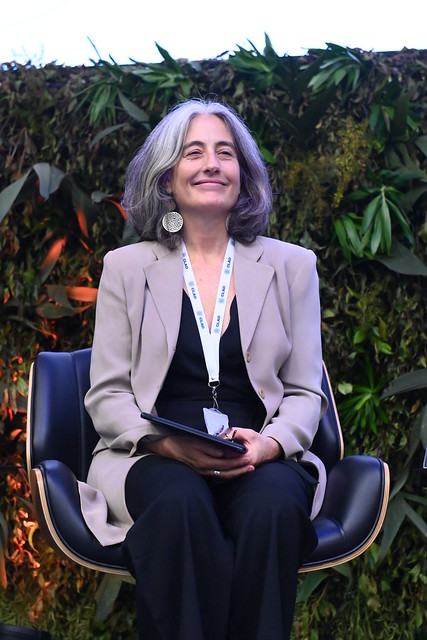 Rebecca Abers em evento


