


How did the growth of a conservative and authoritarian political coalition in Brazilian society and institutions, culminating in the election of a far-right president in 2018, impact public policies and civil society in Brazil?
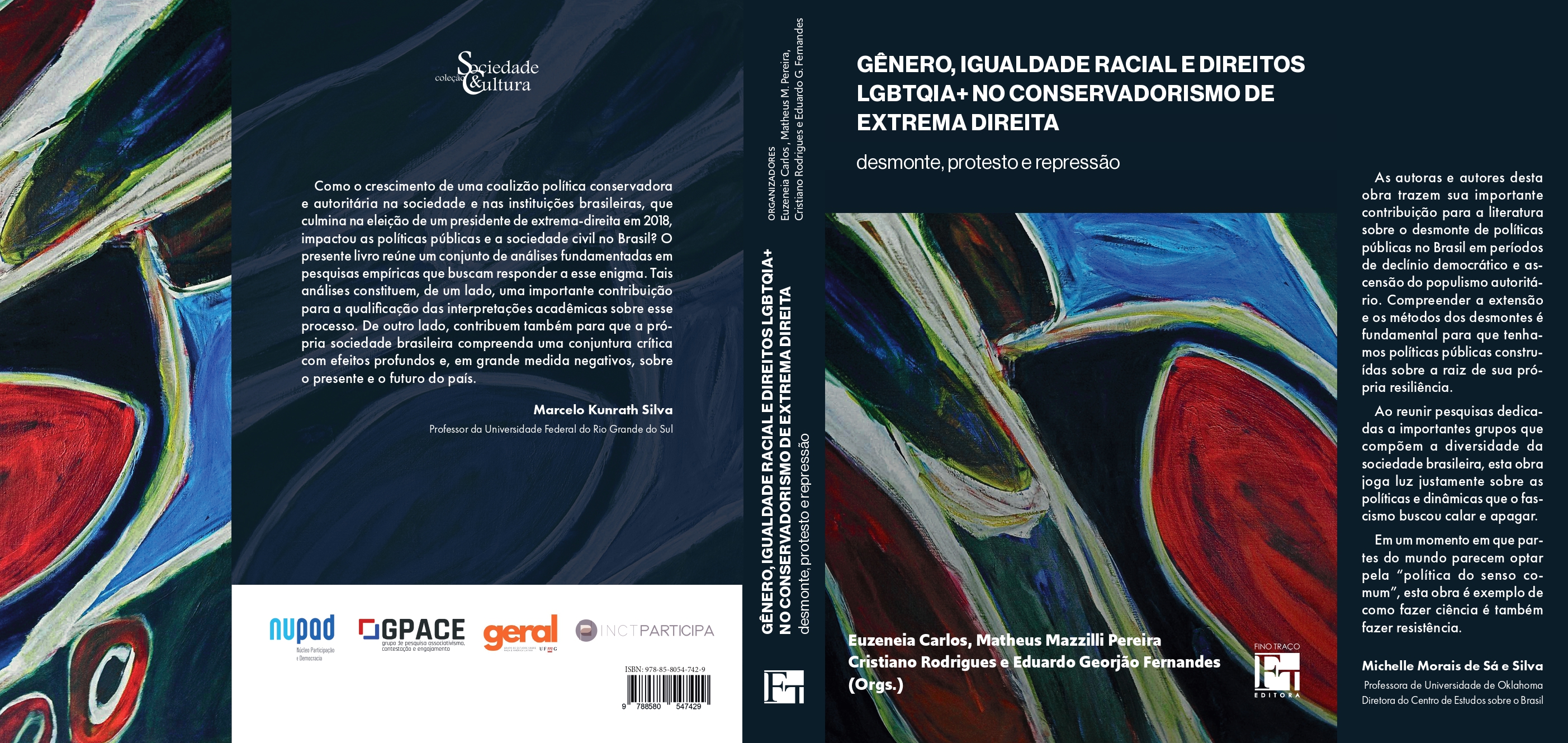
This is the question the book “Gender, Racial Equality and LGBTQIA+ Rights in Far-Right Conservatism: Dismantling, Protest, and Repression,” by researchers Euzeneia Carlos (NUPAD/UFES), Matheus Mazzilli Pereira (GPACE/UFRGS), Cristiano Rodrigues (UFMG) and Eduardo Georjão Fernandes (UnB), seeks to answer, as the result of four years of joint work.
INCT Participa spoke with the four researchers to analyze how the rise of far-right conservatism has reshaped rights, public policies, and participatory arenas in Brazil. Read the key excerpts.
★
What motivated the organization of the book and what gap in public and academic debate does it seek to fill? What is new about the work?
This book is the result of scientific research carried out over four years by a national network of researchers, driven by the need to understand far-right conservatism in Brazil over the past decade—a phenomenon of democratic backsliding with impacts on public policies and civil society.
Changes in the field of human rights were investigated in depth. The book contributes to public and academic debate by demonstrating how the adoption of far-right conservatism in the federal government of Jair Bolsonaro produced transformations in public policies and contentious activism.
The novelty of the work lies in intertwining three analytical dimensions of the far-right phenomenon: policy dismantling, protest, and repression. We argue that transformations in public policies and civil society activism are linked to dynamics of democratic backsliding and government repression driven by the far right in the country, affecting one another.
What were the main impacts of the rise of far-right conservatism on gender, racial equality, and LGBTQIA+ policies in Brazil, according to the research gathered in the book?
The book empirically demonstrates that the dismantling of public policies for women, racial equality, and LGBTQIA+ groups deepened under the Bolsonaro government through a combination of strategies: omission, arena shifting, symbolic action, and active dismantling. In this sense, we argue that dismantling was processual, intentional, and progressive, with policy changes moving from less visible and subtle forms to more visible and active ones, altering public bureaucracies, budgets, policy programs, and social participation.
How did this occur in each of these areas?
The study is revealing in showing how gender mainstreaming was replaced by family mainstreaming in human rights policies. In the field of women’s policies, the emergence of familist policies led to changes in the intensity and density of policies through combined dismantling strategies: arena shifting, symbolic dismantling, and active dismantling.
Policy programs with a gender focus were reconfigured, discontinued, or eliminated, giving women’s policies an anti-gender scope. Maternal and familist programs gained centrality, altering the nature and target population of women’s policies. The reduction in policy density was reflected in the restriction to themes such as labor and violence. This process was marked by a decline in administrative and procedural capacities for policy implementation and by institutional constraints on social participation in councils and conferences.
In the field of racial equality promotion, the impact was equally profound, though with its own specificities. The research identifies three main strategies:
- Arena shifting – institutional displacement of the racial agenda and loss of centrality of the Special Secretariat for the Promotion of Racial Equality (SEPPIR), with a reduction in its hierarchical status.
- Symbolic dismantling – denial of structural racism and the spread of discourses aligned with the idea of “equality for all,” undermining the legitimacy of targeted policies.
- Active dismantling – budget cuts, exclusion of racial issues from the 2020–2023 Multi-Year Plan, weakening of participatory bodies, and reduced programmatic density.
The combination of these strategies produced institutional instability and a retrenchment of racial policy at the federal level. Unlike the gender agenda, discursive attacks often took the form of explicit denial of racism as a structural problem, shifting the issue toward an individualistic and meritocratic framing.
In the case of LGBTQIA+ policies, the Bolsonaro government and the administration of Damares Alves at the Ministry of Women, Family and Human Rights (MMFDH) deepened a dismantling process that had begun during the Dilma Rousseff administration.
However, the Bolsonaro government differed from its predecessors by eliminating the body exclusively dedicated to the issue within the ministry (DPDLGBT), weakening intersectoral and intergovernmental coordination, undermining existing mechanisms of social participation (such as the CNCD/LGBT, which was weakened, and national conferences in the area, which were discontinued), and adopting an anti-gender rhetoric and political agenda framed as “family public policies.”
The book also analyzes forms of resistance and social mobilization in this context. What types of civil society responses appear most relevant?
The book contributes to understanding civil society mobilizations in the field of human rights over the past decade. Many protests took place in opposition to far-right authoritarian backsliding, but also in defense of longstanding demands of feminist, Black, and LGBTQIA+ movements, such as against violence, inequality, and discrimination.
Regarding repression, the persistence of historical and selective policing patterns predominated, with the use of repressive tactics against groups perceived by authorities as more threatening and against more disruptive protests. The book innovates in this area by showing the emergence of the legislative branch as a central arena of dispute over the regulation of the right to protest, identifying a selective tendency among right-wing legislators to legitimize the actions of groups aligned with far-right agendas that mobilized in the streets.
Technical details
Title: Gender, Racial Equality and LGBTQIA+ Rights in Far-Right Conservatism: Dismantling, Protest, and Repression
Editors: Euzeneia Carlos, Matheus Mazzilli Pereira, Cristiano Rodrigues, and Eduardo Georjão Fernandes
ISBN: 978-85-8054-742-9
Pages: 398
Publication: 2025


