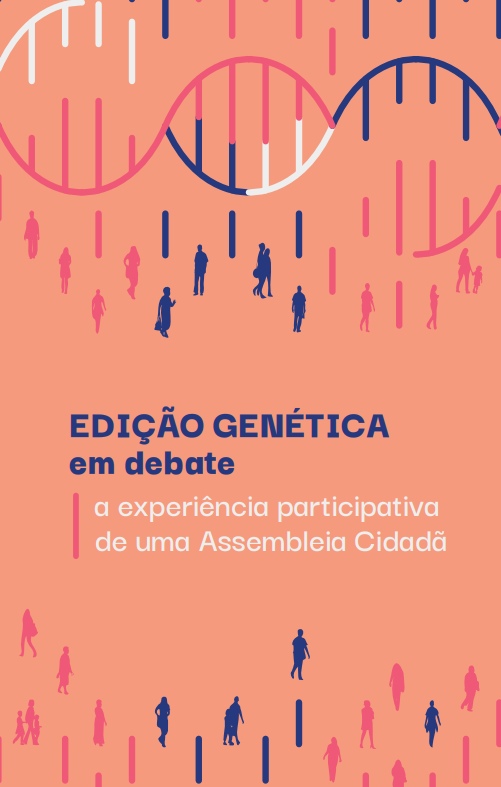
“Anyone can learn about a complex topic, such as gene editing, and should be able to discuss it and help shape decisions that affect all of our lives.” This is how Carla Martelli, coordinator of the Study and Research Group on Participation and Democracy (GEPPADE/UNESP), defines the premise of the movement that gave rise to the book “Gene Editing in Debate: The Participatory Experience of a Citizens’ Assembly,” of which she is one of the editors.
Written in accessible language, the book details the organization of a Citizens’ Assembly in Brazil in 2023—an initiative that brought together researchers and Brazilian citizens from diverse backgrounds to discuss gene editing using CRISPR technology. The work highlights the importance of democratizing technical knowledge, arguing that dialogue between scientists and civil society is essential for ethical decision-making in the field of health.
The book connects the case of the gene editing assembly to broader debates on participation. Martelli emphasizes that democratic participation strengthens science by linking technological progress to the needs and lived experiences of the population.
THE CITIZENS’ ASSEMBLY
The Brazilian project, led by researchers from UFMG in collaboration with other national and international institutions, focused specifically on the use of CRISPR technology in agriculture. Discovered in recent decades, this technology enables radical modification of the DNA of humans and other organisms, with promising applications in health and agribusiness.
Despite its potential, scientific debate around the technology is shaped by geopolitical risks, environmental concerns, and ethical dilemmas. The Assembly’s goal was therefore to discuss the pros and cons of applying the technology in agriculture, incorporating perspectives from experts, affected citizens, and policymakers.
A total of 26 participants were recruited with the support of a research company, ensuring representation from all regions of the country as well as diversity in socioeconomic, educational, religious, occupational, racial, and gender backgrounds.
The process was structured in phases of learning and deliberation, beginning with a foundational training stage using materials (cards, videos, podcasts, texts) shared via WhatsApp to level participants’ knowledge. Ongoing discussions took place in messaging groups, along with four online meetings. Participants also engaged directly with experts who presented a range of perspectives on the topic. The process concluded with the formulation of proposals and regulatory recommendations for CRISPR technology.
The Citizens’ Assembly went beyond an academic exercise, generating tangible outcomes in Brazil’s political and scientific arenas. In addition to submitting participants’ recommendations to relevant national authorities, the project was featured in a public hearing at the Federal Senate’s Committee on Science, Technology, Innovation, Communication, and Informatics, where the Assembly’s recommendations were formally presented.
Martelli notes that the process resulted in mutual learning among organizers, experts, and citizens, reshaping perceptions about the distribution of benefits and risks in scientific development. The book consolidates this experience, serving as both an academic and practical record of the initiative.
It explores the theoretical foundations of participation, deliberation, and science; details the preparation and implementation of the Assembly; and presents evaluation data on the experiment. Rather than merely celebrating the project’s success, it also addresses its limitations and engages with contemporary democratic theory. Led by UFMG, the project involved collaboration with UNESP, the Federal University of Goiás (UFG), and the State University of Maringá (UEM).
The Brazilian Citizens’ Assembly is not an isolated event but part of a transnational movement initiated by the Centre for Deliberative Democracy and Global Governance at the University of Canberra (Australia), which advocates for integrating science, science communication, and democracy. The project is grounded in the idea that any citizen, regardless of technical background, can understand complex issues (such as gene editing) and contribute meaningful knowledge to decisions that affect collective life.
The two most recent editions of Radar Participa address similar initiatives carried out in Australia and France.
Technical information
Title: Gene Editing in Debate: The Participatory Experience of a Citizens’ Assembly
Authors: Filipe Mendes Motta; Yurij Castelfranchi; Ricardo Fabrino Mendonça; Carla Almeida; Carla Gandini; Giani Martelli; Cláudia Feres Faria; Fernando Filgueiras; Lucas Veloso; Mateus Ferrari Canela; Victor Menegassi
ISBN: 978-65-87808-54-3
Pages: 160
Publication: 2025
Access the PDF.